

Fire Evacuation Signs Explained: Best Practices for Installation and Compliance in the UK
Fire evacuation signs are one of the most critical yet frequently overlooked elements of workplace safety in the United Kingdom. Whether you manage a small retail unit or a large commercial premises, understanding how these signs work, what they must communicate, and how to keep them compliant is essential for protecting everyone on site.
In brief
- Fire evacuation signs are essential for workplace safety in the UK, providing clear instructions for exits, equipment locations, and hazards during emergencies.
- UK legislation, including the Regulatory Reform (Fire Safety) Order 2005, legally mandates that employers and building owners maintain visible and appropriate fire signage.
- Standardised colour coding and symbols, based on the BS ISO 7010 regulation, ensure that fire safety messages are consistent and universally recognisable across different premises.
- Fire risk assessments are the mandatory starting point for determining the necessary types and placement of signs to address specific building risks.
- Effective installation requires placing signs at all exits and junctions, while utilizing photoluminescent or illuminated signs to ensure visibility during power failures or low-light conditions.
- Maintaining compliance involves regular monthly inspections and annual audits to ensure signs are not damaged, obscured, or outdated due to changes in building layout.
Understanding Fire Evacuation Signs and Their Role in UK Safety Regulations
Across commercial premises throughout the UK, fire safety signs serve as silent but vital communicators in any emergency. They direct occupants towards exits, identify firefighting equipment, highlight hazards, and reinforce safe behaviour, all within a matter of seconds. In high-stress situations, clear and well-placed signage can make an enormous difference to evacuation outcomes. It is worth noting that when a fire extinguisher is deployed promptly, the vast majority of fires can be tackled within just two minutes, which underscores precisely why the location of fire-fighting equipment must be unmistakably signed.
What fire evacuation signs must communicate and why
UK regulations identify several distinct categories of fire safety signage, each designed to convey a specific message. Fire Action Notices must be displayed in commercial premises and should set out the key steps occupants need to follow in the event of a fire. Emergency exit route signs (typically rendered in green and white) guide people towards the nearest safe exit, particularly in buildings where escape routes are not immediately obvious. Fire equipment signs point occupants towards extinguishers, hose reels, and alarm call points, whilst warning and prohibition signs alert people to specific hazards or restricted behaviours, such as smoking bans in areas where flammable materials are present.
Colour coding plays a fundamental role in making these messages instantly recognisable. Red is associated with prohibition and fire equipment, green with emergency exits and first aid, yellow or amber with hazard warnings, and blue with mandatory actions. This standardised system, rooted in BS ISO 7010, ensures that signs are consistent and recognisable across the UK and throughout Europe, reducing confusion during an evacuation.

Key Legal Requirements Governing Fire Safety Signage in the UK
The primary legislative framework for UK fire safety regulations rests on two key instruments: the Regulatory Reform (Fire Safety) Order 2005 and The Health and Safety (Safety Signs and Signals) Regulations 1996. Together, these pieces of legislation place a legal obligation on responsible persons (typically employers or building owners) to ensure that appropriate fire safety signage is in place, properly maintained, and clearly visible at all times. Failure to comply can result in fines, legal action, and, most critically, risk to life.
A fire risk assessment is a mandatory starting point for any premises. This process identifies the specific risks present, determines which signs are necessary, and informs where they should be positioned. Records of these assessments must be kept and made available for inspection. It is also important to note that the guidance published by the Home Office applies specifically to England and does not extend to Wales, Scotland, or Northern Ireland, where separate rules may apply.
Best practices for installing fire evacuation signs across your premises
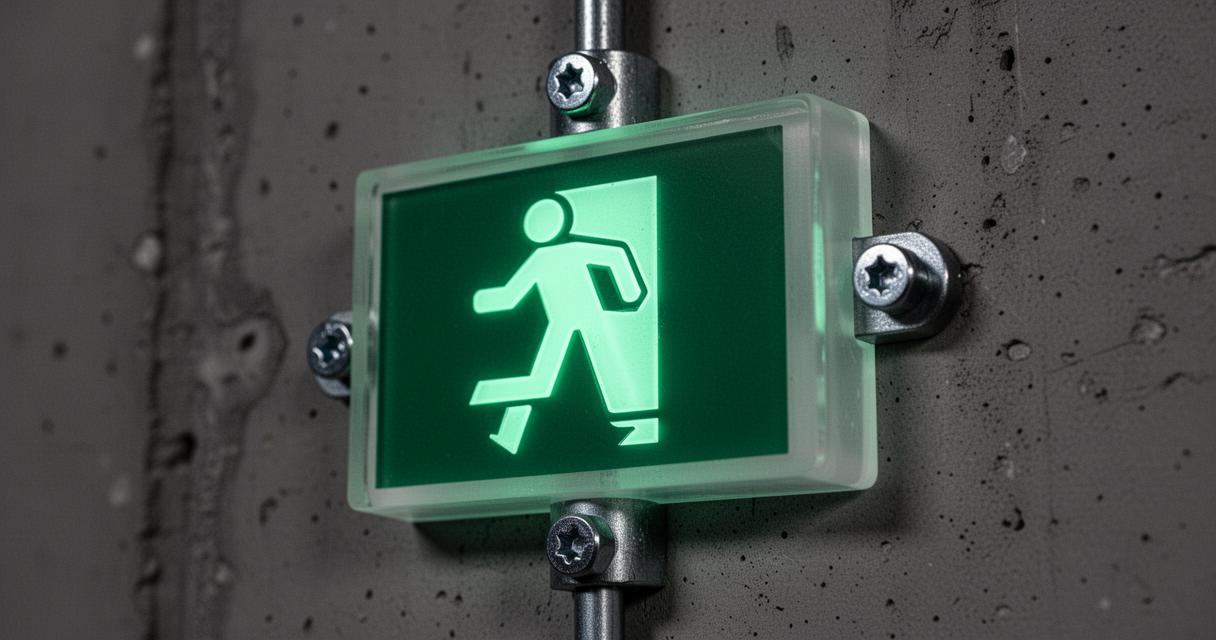
Once you understand the legal landscape, the practical work of installing effective fire exit signage begins. Getting placement, visibility, and sign type right requires careful planning, particularly in buildings with complex layouts or varying light conditions.
Choosing the Right Placement and Visibility for Maximum Effectiveness
Exit signs must be installed at all exits and at every change of direction along an emergency evacuation route. They should be positioned above doorways, in communal corridors, and at any junction where an occupant might otherwise hesitate. Dimensions matter too, sign sizes typically range to suit the visibility distance required, ensuring that even those furthest from an exit can clearly read the message.
In conditions where lighting may fail, photoluminescent exit signs offer a reliable solution. These signs absorb ambient light and then glow in the dark, making them particularly well-suited to areas that may be difficult to access during a power outage. Illuminated electric signs remain a popular choice for larger buildings with more complex layouts, where consistent brightness is essential. All signs used in low-light or no-light conditions must meet the relevant standards to be considered compliant.
The fire assembly point must also be clearly sign-posted outside the building, in a location that keeps evacuees safely away from the structure itself. Every fire door should carry a clearly visible sign (typically reading “Fire door, keep shut”) along with any necessary instructions for operation. Common mistakes to avoid include:
- Incorrect placement that creates confusion at junctions or near obstacles
- Missing directional arrows on exit route signs
- Using non-standard symbols or colours that fall outside BS ISO 7010
- Overcrowding walls with too many signs, which can overwhelm rather than inform
- Neglecting the accessibility needs of all building users

Maintaining and Reviewing Your Fire Signage to Stay Compliant
Installing signs correctly is only part of the obligation. Fire safety signage maintenance requires ongoing attention to ensure that every sign remains visible, undamaged, and accurately reflects the current layout of the premises. Regular inspections (ideally carried out monthly) allow you to identify signs that have faded, been obscured, or become damaged. Annual audits provide a more thorough opportunity to review whether the overall signage strategy still reflects the findings of your fire risk assessment, particularly if the building layout or occupancy has changed.
Damaged or outdated signs should be replaced promptly. Workplace fire safety is not a one-time exercise but an ongoing commitment that forms part of a broader culture of fire safety compliance. When combined with well-maintained emergency lighting, regular fire drills, and thorough staff training, a properly signed premises becomes a significantly safer environment for everyone who passes through it.